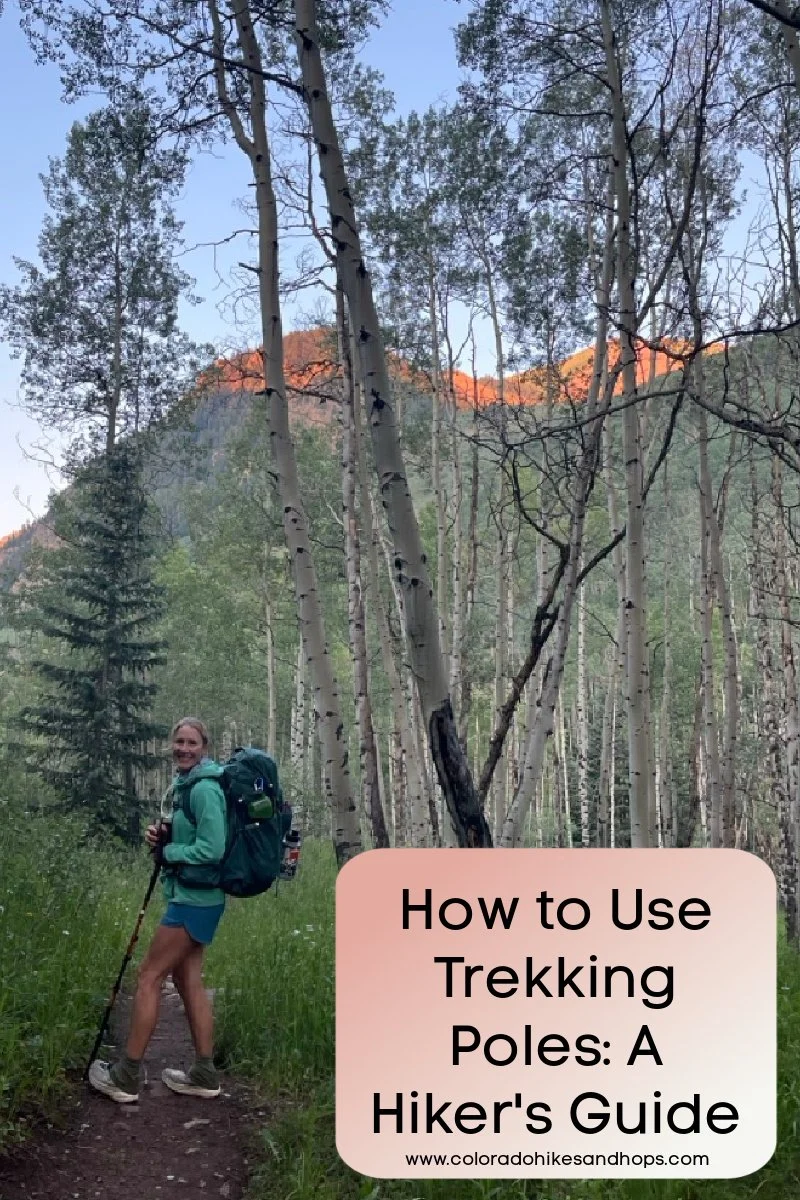
Best Hiking Poles for Colorado Trails (2026): Our Real Picks
This page contains affiliate links. If you make a purchase via a link on this page, we make a small commission at absolutely no extra charge to you. Thank you for your support of this small women-led business.
The trekking poles we actually carry on Colorado trails, from ultralight carbon to the cork grip pair I’ve hiked with for six years. Plus how to size and use them.
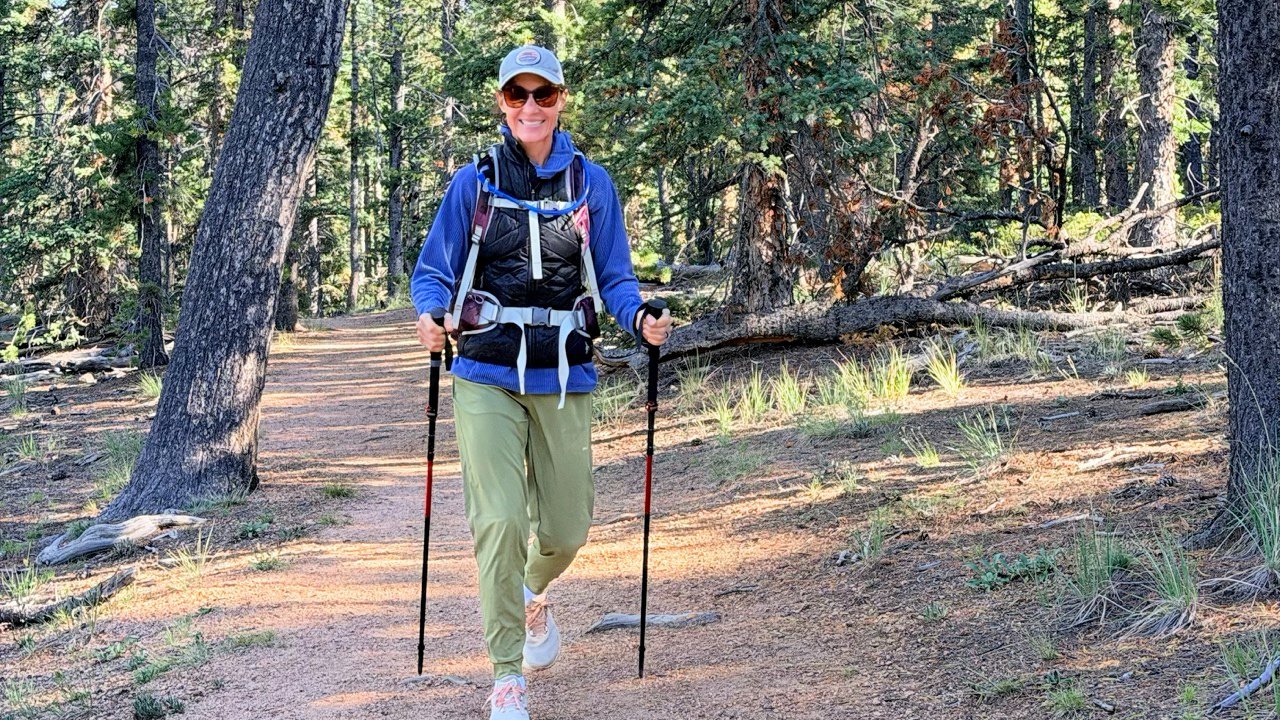
The Best Hiking Poles for Colorado Hikers (2026)
I spend a lot of hours on the trail. Long days, big mileage, segments of the Colorado Trail with a full pack.
On days like that, trekking poles are not an accessory. They are part of how the walking gets done.
In my twenties I judged the hikers with poles. I was wrong. Now I carry them on every big hike, and so does Tanya.
Here are the poles we actually hike with, what each one does best, and how to use them once they’re in your hands.
Our Quick Picks
- Lightest and most packable: MSR DynaLock Ascent Carbon
- Best for long days: Black Diamond Trail Ergo Cork
- Best folding pole: Black Diamond Distance Carbon FLZ
- Best way to start: Rent from REI or buy used
Table of Contents
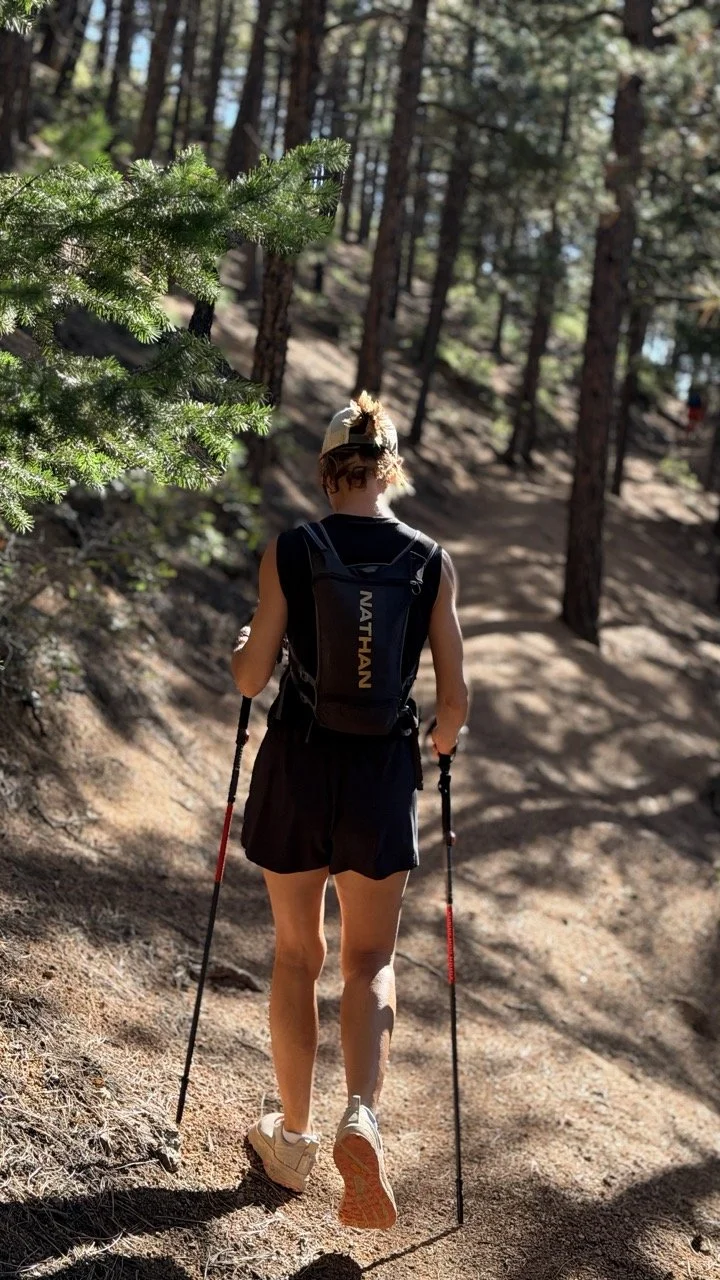
Our Favorite Trekking Poles
MSR DynaLock Ascent Carbon (my new top pick)
New poles, new favorite. After one long day on the trail, these are making a real case to unseat the Black Diamonds I have carried for six years.
Two things sold me.
They weigh about a pound for the pair, carbon reinforced with Kevlar, so they nearly disappear on a climb. And they fold down tighter than anything I have owned, to about fourteen inches, small enough to vanish into a side pocket.
The DynaLock levers snap to length with no twisting, and winter and summer baskets come in the box.
One caveat. These are new to me, just a few hikes in. My Black Diamonds earned their spot over six years, and the real question is how the foam grips hold up over time. Ask me again next spring.
Quick specs: about 1 lb per pair, folds to roughly 14 inches, adjusts 100 to 120 cm, foam grip, winter and summer baskets.
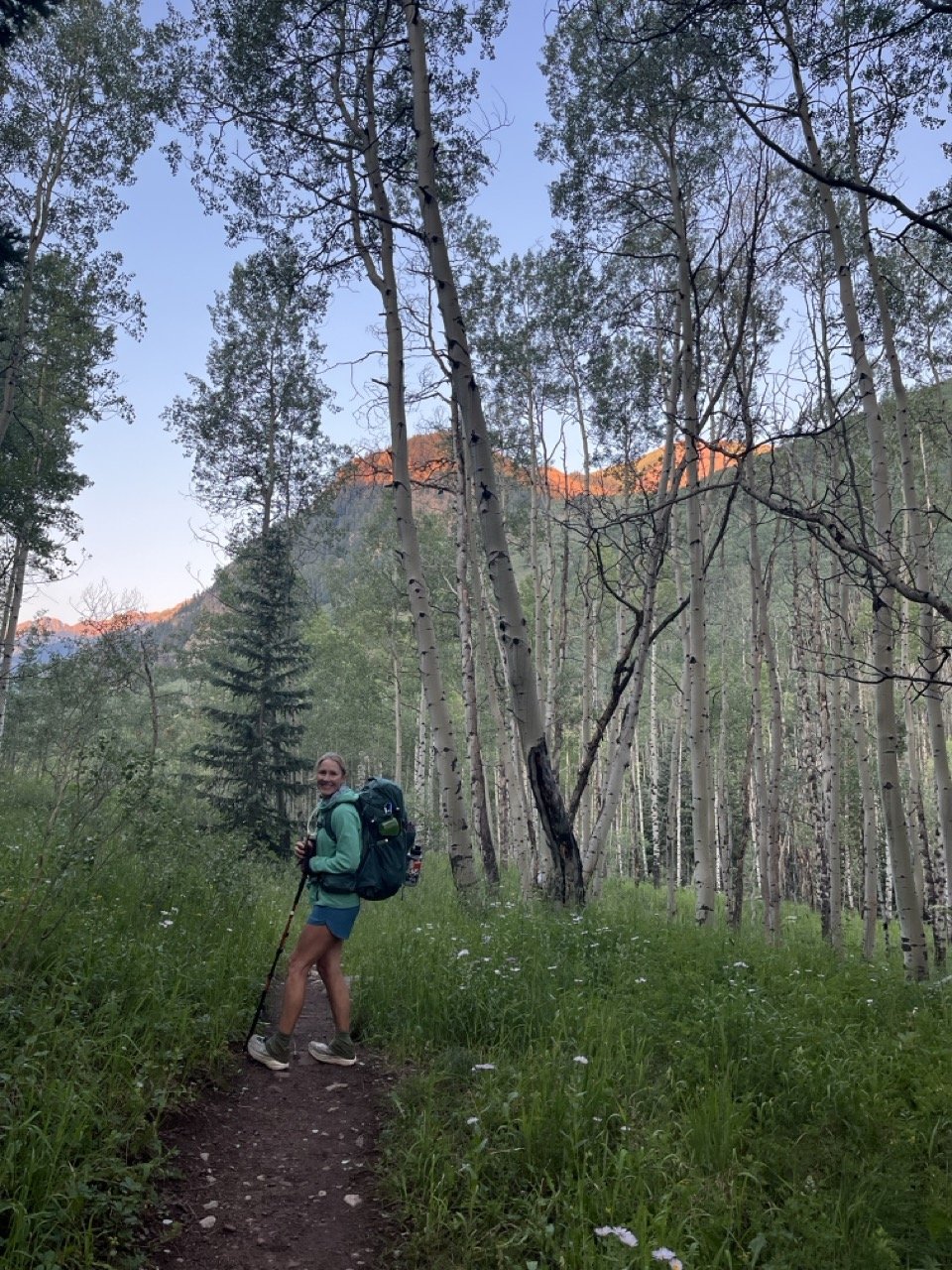
Black Diamond Trail Ergo Cork (six years and still my benchmark)
Six years, the Four Pass Loop, Conundrum, the Zirkel Circle and more fourteener descents than I can count. These poles have been on all of it. They were my pick for a long time, and they set the bar the MSRs are now trying to clear.
The Black Diamond Trail Ergo Cork are my workhorses. The adjustable length is what sold me. I can shorten them for the climb and lengthen them for the descent without fuss.
The cork grips are the other reason. Cork softens over time and molds to your hands, and it stays comfortable on the long days when sweat would make foam or rubber slick.
At around 18 ounces, they are light enough to forget you are carrying them. They collapse a little long for packing, which is my only gripe, and a small one.

Black Diamond Distance Carbon FLZ (Tanya's pick)
Tanya hikes with the Black Diamond Distance Carbon FLZ. These fold into three sections like a tent pole, which makes them easy to stash in or on a daypack when you hit a stretch you do not need them.
At about 12 ounces, the carbon construction is noticeably lighter in the hand.
Carbon costs more, but for the weight savings and packability, she swears by them.
Trekking Poles Compared
| Pole | Best for | Weight (pair) | Grip | Style |
|---|---|---|---|---|
| MSR DynaLock Ascent Carbon | Lightest and most packable | About 1 lb | Foam | Folding, adjustable |
| Black Diamond Trail Ergo Cork | Long days, durability | About 18 oz | Cork | Telescoping, adjustable |
| Black Diamond Distance Carbon FLZ | Folding, fast to stash | About 12 oz | Foam | Folding, adjustable |
Specs are approximate and vary by pole size.
How to Choose Trekking Poles
A few things to weigh when you choose, without going down a rabbit hole.
Material
Aluminum is durable and affordable and shrugs off abuse, but it weighs a little more. Carbon fiber is lighter and absorbs more shock, but it costs more and can be less forgiving of a hard sideways pinch between rocks. Either one will serve you well. Pick based on your budget and how much weight matters to you.
Adjustable vs. folding
Adjustable telescoping poles let you fine-tune length for climbs and descents. Folding poles pack smaller and deploy fast. I prefer adjustable for the terrain control. Tanya prefers folding for packability. Both are right.
Grips
Cork molds to your hand and handles sweat best. Foam is soft and light. Rubber is fine for cold weather but can get slick when your hands sweat. Cork is my pick for long days.
Price
Solid poles run from about $30 to $50 at the budget end, $150 to $180 in the dependable mid-range where most good options live, and $200 and up for premium carbon. Reputable brands to look at: MSR, Black Diamond, LEKI, and Mountainsmith.
You do not need fancy poles to start. You need the right height, the straps used correctly, and a willingness to let them do their job.
Get those three things down and you will wonder how you ever hiked without them.
Best Way to Start: Rent or Buy Used
Not sure you are ready to buy? REI rents Black Diamond Poles for around $20 a day. Take a pair out on a real trail before you decide. And thrift stores and used gear shops turn up solid used poles more often than you would think. That is how I got my first decent pair.

How to Use Trekking Poles
Good poles only help if you use them right. Here is what I’ve learned over a lot of Colorado miles.
The case for poles is simple. They take load off your lower body and spread it across your arms and shoulders.
Research backs this up. Using poles can reduce the compressive force on your knees by up to twenty five percent.. On a long descent with a loaded pack, that is the difference between finishing strong and limping the last two miles.
There is an endurance piece too. Poles bring your upper body into the work, so the effort gets shared instead of pounded into the same joints all day. On the Colorado Trail, with the extra pack weight, that sharing is what keeps me going when the day stretches long.
A few more things they do, quietly, all the time:
Steady you on uneven ground and loose rock.
Give you two extra points of contact on water crossings.
Save you on the descents, where most knee pain actually happens.
Double as tent poles for many ultralight shelters, if you backpack.
I used poles on every segment of the Four Pass Loop, Conundrum and Zirkel Circle. They all have the kind of terrain where a third and fourth point of contact matter. I would not want to do any of these hikes without them.
How to Size Trekking Poles
Get the height right and everything else gets easier. Get it wrong and you will fight your poles all day.
Here is the method:
Stand on flat ground.
Hold the poles with the tips on the ground beside your feet.
Adjust the length until your elbows sit at a 90-degree angle.
That is the baseline. Your forearms should be roughly parallel to the ground when you grip the handles.
Most decent poles are adjustable, which matters more than people think. You will want to shorten them a little on long climbs and lengthen them a little on long descents. More on that below. If you hike a lot of steep Colorado terrain, adjustability is not optional in my opinion.
A note on women's poles, because the question comes up.
The real difference is not the gender label. It is grip diameter and length. Women's poles usually have a thinner grip for smaller hands and a shorter range, which also makes them pack down smaller. If you have smaller hands, the thinner grip is genuinely more comfortable over a long day, no matter what the marketing calls it.
How to Use the Straps (Most People Get This Wrong)
This is the one almost everyone does backward, and it is the single biggest fix I can give you.
Do not just grab the handle with the strap dangling. The strap is load-bearing. Used right, it lets your hand relax and transfers your weight into the pole through your wrist instead of your grip.
Here is how:
Bring your hand up through the bottom of the strap loop.
Then bring your hand down onto the grip, so the strap runs under your palm.
Hold the grip loosely. Let the strap take the weight on the push.
Once you feel it, you will not go back. Your hands stop cramping. You stop white-knuckling the handles. On a long day this is the difference between sore, swollen hands after the hike and hands that feel fine.
If your hands swell on the trail anyway, loosen the straps a touch and keep your grip light. The poles do the work. You just guide them.
How to Use Trekking Poles Uphill
On climbs, shorten your poles slightly. A few centimeters is enough. Shorter poles keep your hands from riding up too high and let you plant in front of you for leverage.
Plant the pole and push down and back as you step up. You are giving yourself a little assist on every stride, pulling some of the climb into your arms. On a long grind, that adds up.
Keep the rhythm natural. Opposite hand to opposite foot, the same way you already swing your arms when you walk. Do not overthink it. Your body knows the pattern.
How to Use Trekking Poles Downhill
This is where poles earn their keep. It is also where knees get wrecked.
Lengthen your poles slightly for the descent. Longer poles let you reach down to the lower ground without hunching forward.
Plant the poles ahead of you and let them carry some of your weight as you step down. You are braking with your arms so your knees do not have to absorb the full impact. On a steep, loaded descent off a high pass, I can feel the difference within minutes.
Take it in control. Short steps. Poles leading. Let them be the brakes.
I lean on this most coming down the fourteeners. The descent is the part that beats you up, and the poles are why I can do another one the next weekend.
Poles on Colorado Terrain: Scree, Snow and Water
Our trails ask specific things of your poles. A few notes from years out here.
Scree and loose rock
This is where the extra points of contact save you. Plant deliberately, test before you commit your weight, and let the poles catch you when a rock shifts. On loose talus, poles are the reason you stay upright instead of sliding.
Snow and spring conditions
Switch to your poles' snow baskets if you have them. The wider basket keeps the pole from punching straight through soft snow. Worth carrying into late spring up high, when the trails are still holding drifts.
Water crossings
Two poles, planted upstream, give you a stable tripod against the current. Face slightly upstream, plant, then move one point of contact at a time. I have crossed plenty of cold, pushy creeks this way without a slip.
Tips for the surface
Use the rubber tips on rock and pavement for grip and quiet. Pull them off for the carbide points on dirt, snow, and ice, where you want the bite.
Trekking Poles FAQ
Are trekking poles worth it for day hikes?
On short, flat trails you may not need them. On anything steep, rocky or long, yes. They take some of the load off your knees on the descent, which is where most knee pain happens.
Carbon or aluminum trekking poles?
Carbon is lighter and absorbs more shock. Aluminum costs less and handles abuse better. Choose based on your budget and how much weight matters to you.
How long should my trekking poles be?
With the tips on the ground beside your feet, your elbows should sit at about 90 degrees. Shorten them slightly for climbs and lengthen them for descents.
Do women need women’s trekking poles?
Not necessarily. The real difference is grip size and length range. If you have smaller hands, a thinner grip is more comfortable on a long day.
I have a lot of trail left in me. The poles are part of why.
See you out there.